Historical Place
The “KdF Seaside Resort of Twenty Thousand”
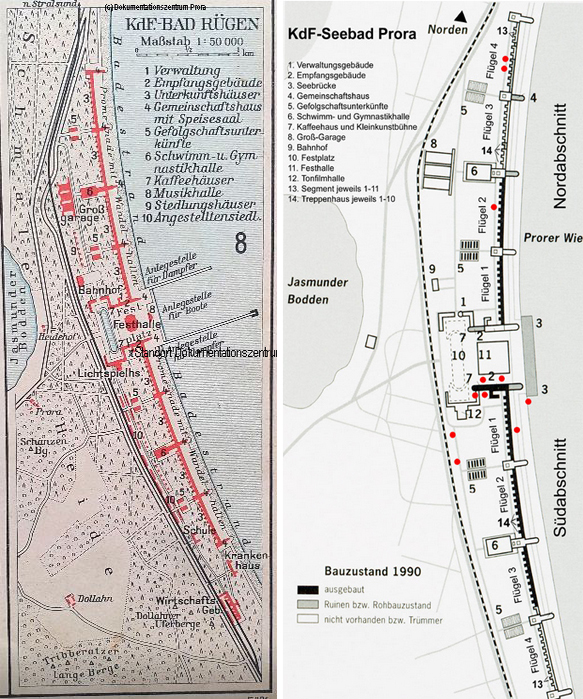
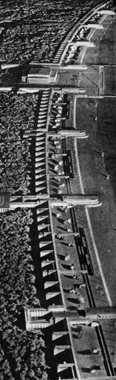
In the 1930s, the eastern coast of Rügen, with its wide white beach and pine forests, changed dramatically. The Nazi organization “Strength Through Joy” (Kraft durch Freude, KdF) built a 4.7 km long row of buildings at Prorer Wiek. It consisted of eight blocks, each almost 500 m long. The project was called the “KdF Seaside Resort Rügen”.
The resort was planned to provide 20,000 beds. It was meant as a holiday destination for the Nazi idea of a “people’s community”. This included only those Germans whom the regime defined as being “of German blood” and who showed loyalty to National Socialism. People excluded from this so-called community were not allowed to go on holiday. In the worst cases, they were persecuted and imprisoned in concentration camps.
“Strength Through Joy” was part of the “German Labour Front”. Its main task was to organize leisure time for the German population, especially holidays.
The leader of the German Labour Front, Robert Ley, claimed that Hitler himself had proposed the idea of building five large KdF seaside resorts. In reality, only Prora was ever built. In early 1936, an architectural competition was announced with eleven participants. There were strict rules: all rooms had to face the sea, and a festival hall had to hold 20,000 people. Hitler allegedly chose the design by Cologne architect Clemens Klotz. The central festival hall was planned by Erich zu Putlitz.
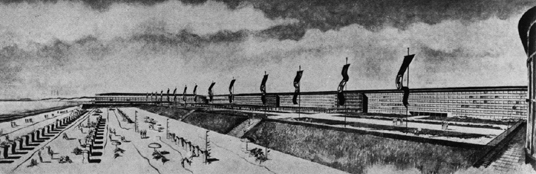
Architectural perspective based on the design by Clemens Klotz, 1936
(Source: “Illustrierte Zeitung”)
On 2 May 1936, the foundation stone was laid. The date marked the third anniversary of the destruction of the German trade unions by the Nazi regime. The ceremony was a large public event and was broadcast on the radio. Units of the navy and air force were present. Robert Ley gave the main speech.
Construction work began in April 1938 with the foundations. By the summer of 1939, the main residential blocks and the central buildings were completed as unfinished structures. When the Second World War began in 1939, all construction stopped. The building companies were reassigned to projects important for the war.
In 1940 and 1941, several police battalions were trained in Prora. Each unit consisted of about 800 policemen. They were later deployed behind the front lines across Europe. From 1942 until the end of the war, the buildings were used to train young women as naval communications assistants. In 1944, a military hospital was set up. These uses had already been planned in the original architectural competition.
Prora in the Soviet Occupation Zone and the GDR
In early May 1945, Soviet troops occupied Prora. For more than ten years, they used what is now Block V to house soldiers. The southernmost block and the two northernmost blocks were demolished. Some buildings originally planned for staff accommodation were temporarily used by refugees from eastern regions that became part of Poland, especially Pomerania.
In 1949, the refugees had to leave the site. Police units then moved into Prora and converted the buildings into barracks. The southernmost surviving block became a recreation home for officers. In 1952, these police units formed the “Barracked People’s Police” (KVP). In January 1956, it became the “National People’s Army” (NVA) of the GDR.

At first, combat units were stationed in Prora. Later, military training institutions dominated the site. These included the “Erich Habersaath” Military Technical School and, from 1981, the “Otto Winzer” Officers’ College for foreign military personnel.
From 1982, Prora also became the largest site for so-called “construction soldiers”. These were conscientious objectors who served in the NVA without weapons and carried out construction work, including the building of the Mukran ferry port.
Until 1991, the former KdF Seaside Resort remained a restricted military area. After German reunification in 1990, the site was handed over to the Bundeswehr, which left Prora in 1991.
Prora after 1989
When the Bundeswehr left Prora in 1991, the site became property of the Federal Republic of Germany. Since then, authorities have tried to sell and develop Prora for commercial use.
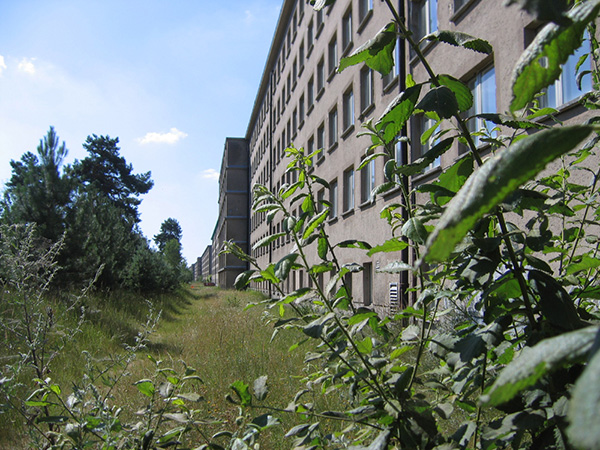
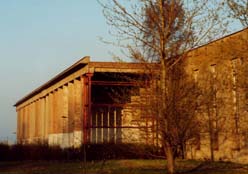
In 1994, Prora was listed as a protected historic monument. The official statement described it as a unique architectural complex that was intended to become the largest seaside resort in the world and an important example of 1930s construction technology.
Blocks I and II were sold to private investors in 2006, Block III in 2005. Hotels, holiday apartments, wellness and sports facilities were built. The first fully renovated part was the youth hostel in Block V in 2011. Construction resumed in 2012, and the first apartments were occupied in 2014. By 2024, Blocks I, II and IV were fully renovated, Block III mostly completed. The southern part of Block V was sold in 2019 and has been under renovation since 2023. The ruins of today’s Block VII were sold to an investor in 2004 and resold in 2020, even though construction is not allowed there under current planning regulations.